Join families around the world helping their kids speak a new language with Voiczy.
Free for 7 days. Cancel anytime.
Published on:
Quick answer: To homeschool your child, first confirm your local legal requirements and file any notice that is due. If your child is coming out of school, take a few weeks of deschooling before starting formal work. Then build a daily rhythm rather than a timetable: hardest subject first, short lessons, movement in the middle, and one protected independent block. Keep math and reading individual per child and combine everything else. Expect one to two focused hours a day for young children and three to five for teens. Outsource the subjects you cannot teach yourself, keep a one-line-a-day log plus a work portfolio, and commit to two recurring activities outside the house. Above all, protect the parent's capacity — burnout, not curriculum, is what ends most homeschools.
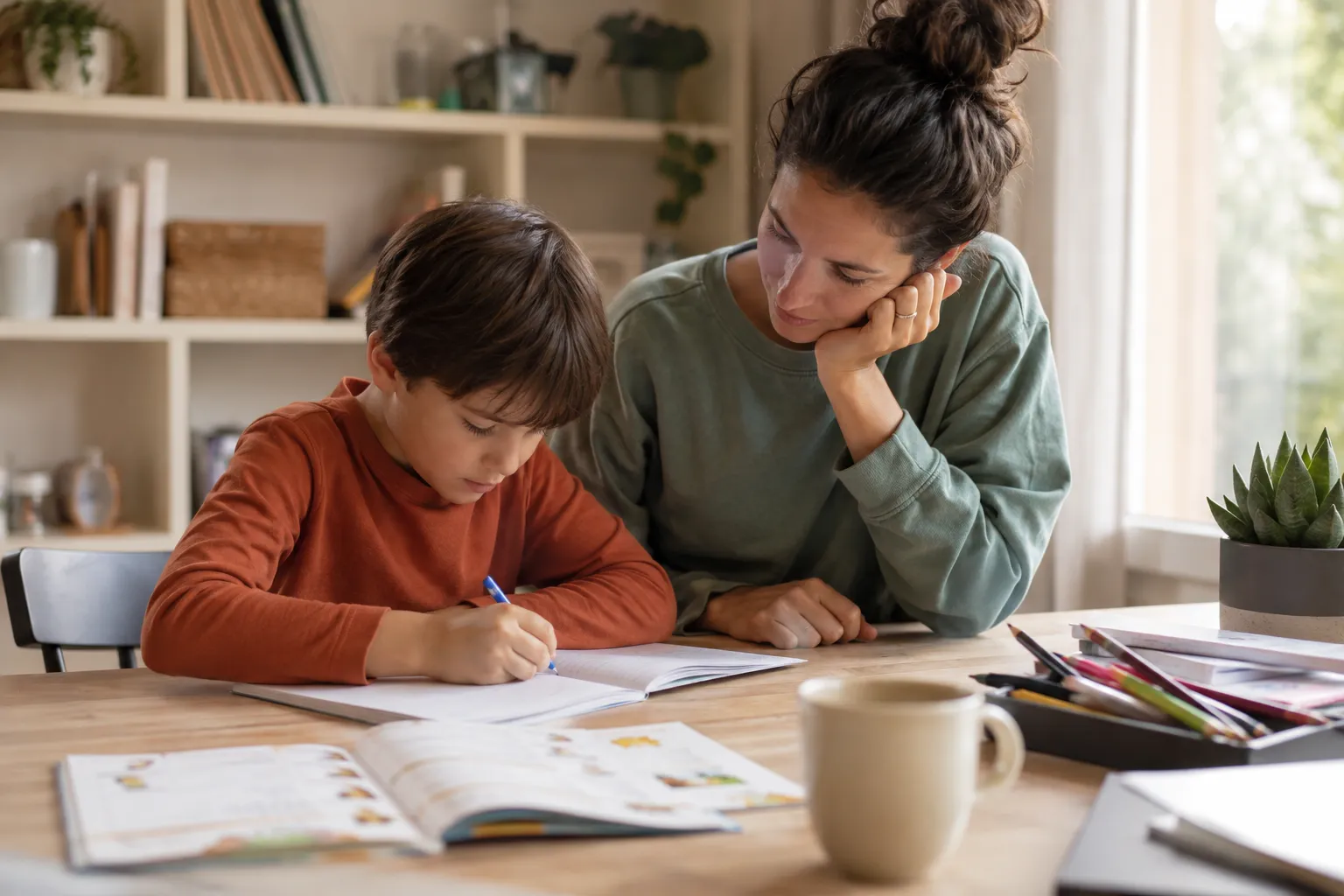
Most homeschooling advice falls into one of two traps. It either shows you a spotless farmhouse table with four children quietly doing calligraphy, or it hands you a 200-page state regulation PDF and wishes you luck. Neither one tells you what to do on a Tuesday morning when your six-year-old is under the table and you still haven't had coffee.
This guide is the other kind. It covers the decisions that actually determine whether homeschooling works for your family: how you structure a day, which method fits your child, what to do about the subjects you can't teach yourself, how socialization really happens, and how to keep records without turning your life into an audit. We work with homeschooling families every day, and the patterns below come from what we see working.
Before curriculum, before schedules, get specific about why you are doing this. Your reason quietly determines every later choice, and vague reasons produce vague homeschools.
Families usually land in one of a few camps:
Write your reason down in one sentence and keep it somewhere visible. In February, when it is dark and someone is crying over fractions, that sentence is what tells you whether to push through or change the plan. A family homeschooling for pace should be flexible about content; a family homeschooling for heritage language should be flexible about schedule but ruthless about daily language exposure. Same activity, different priority, because the "why" differs.
This is the least fun section and the one you cannot skip. Homeschooling rules vary enormously, and they vary by country and by region within a country.
Depending on where you live, you may need to:
In some countries homeschooling is straightforward and common. In others it is heavily restricted, and families use international online schools or relocate instead. Germany is the most-cited European example: compulsory school attendance is enforced, and in Konrad v. Germany (no. 35504/03, 2006) the European Court of Human Rights held that refusing an exemption did not violate parents' Convention rights. The Netherlands takes a different route, granting exemption from enrollment only on narrow grounds — including richtingbezwaren, a formal objection that no school within reach matches the family's beliefs — which must be filed with the municipality before 1 July each year. Rules also change, and some are actively under review, so check the current version rather than an older summary.
Check your own jurisdiction's current rules with an official government source or a national home-education association before you make any decisions. Do not rely on a blog post, including this one, for legal specifics.
Two practical tips. First, find your country or state's home-education association. They usually maintain a plain-language summary of the law that is far more readable than the statute. Second, if you are withdrawing a child mid-year from an existing school, do the paperwork in the correct order — notice first, withdrawal second, in most places — so you never have an unexplained absence gap on record.
If your child has been in a classroom, do not start homeschooling on Monday with a full timetable. You will both hate it.
Children coming out of school carry habits that make home learning harder: waiting to be told what to do, working for marks rather than interest, and in many cases a bruised sense of whether they are "good at" a subject. Adults carry the matching habit of recreating a classroom in the living room, complete with a bell schedule and a wall of laminated posters.
Deschooling is a deliberate transition period — a rough rule of thumb is about one month for each year your child was in school, though it varies widely — where you do almost no formal academics. You read together, cook, go to museums and libraries, take walks, build things, and let your child be bored long enough that they start generating their own ideas again.
It feels like doing nothing. It is not. You are gathering the most valuable data you will ever have about your child: what they pick up when nobody assigns it, how long they can concentrate on something they chose, what time of day their brain actually works, and which subjects carry emotional baggage. Every one of those facts improves the plan you write next.
One thing worth keeping alive during deschooling: anything with a daily-habit component, like a musical instrument or a second language. Habits are much easier to maintain than to restart.
Homeschooling methods are strong opinions about what learning is. You do not have to marry one. Most experienced families end up eclectic, borrowing the parts that fit each child. Here is what you are choosing between.
Traditional / school-at-home. A boxed curriculum, textbooks, tests, and a schedule that mirrors school. Highest structure, lowest planning burden, easiest to defend to a skeptical relative or assessor. It can also import exactly the problems that made you leave school, and it tends to be the fastest route to burnout for both of you.
Classical. Organised around the trivium: grammar (memorising facts) in the early years, logic (analyzing and arguing) in the middle years, rhetoric (expressing ideas persuasively) in the teens. Strong on history, literature, formal writing, and often Latin. Demanding and rigorous; excellent for a verbally-oriented child, heavy going for one who needs to move.
Charlotte Mason. Short lessons — often 15 to 20 minutes for young children — built on "living books" rather than dry textbooks, plus narration (the child retells what they heard in their own words), nature study, copywork, and habit training. Gentle and genuinely enjoyable, and narration is one of the most effective low-tech comprehension tools that exists.
Montessori. A carefully prepared environment, hands-on materials, long uninterrupted work periods, and the child choosing their work within limits. Superb for early years and for building independence. The authentic materials cost money and the method takes real study to implement well.
Unit studies. Pick a theme — Ancient Egypt, volcanoes, the ocean — and pull every subject through it. Efficient for teaching several ages at once and great for engagement. Watch the gaps: math in particular does not slot neatly into a theme and normally needs its own sequential track.
Unschooling / child-led. No imposed curriculum; learning follows the child's interests, with the parent acting as resource-finder and conversation partner. When it works it produces spectacularly motivated learners. It demands a very engaged, resource-rich parent, and it is the hardest model to evidence if your jurisdiction requires documentation.
A practical way to decide: pick your math spine first and make it sequential and non-negotiable, because math punishes gaps more than any other subject. Then choose how you want to handle reading and writing. Then let everything else — history, science, art — be as loose, thematic, or interest-led as suits your family. That single structural decision resolves most method anxiety.
New homeschoolers build hour-by-hour timetables. Those timetables survive about four days, and their collapse feels like personal failure. Build a rhythm instead: a reliable order of events, not a clock.
A rhythm sounds like: morning basket, then the hard subject, then movement, then the lighter subjects, then lunch, then independent or project work, then reading aloud. If everything shifts ninety minutes because the dentist ran late, the order still holds and nobody has failed at anything.
A few things that make rhythms work:
Do the hardest thing first. Whatever your child resists most — usually math or writing — goes in the first working slot, when willpower is highest. Dread grows all day if you leave it until the afternoon.
Keep lessons genuinely short for young children. Focused attention is finite and age-linked. For a five- to seven-year-old, 15 to 20 minutes per subject is a real session, not a token one. Four short, sharp sessions beat one long session where the last thirty minutes are pure friction. Stop while it is still going well.
Use a morning basket. Fifteen to thirty minutes of everyone together: read-aloud, a poem, a song, a map, one interesting fact. It starts the day connected rather than adversarial, and it is where multi-age families do their best shared learning.
Protect an afternoon block for the parent. Independent reading, audiobooks, a screen-based lesson, quiet building. You cannot facilitate for eight hours. Nobody can.
Expect the real number of hours to surprise you. One-to-one teaching has no queue, no register, no transitions, no crowd control. Focused academic work often lands around one to two hours a day for young children and three to five for teens. If you finish "early", you have not cheated — you have removed the overhead.
Here is a rhythm that works for a lot of families with a 6- to 9-year-old:
| Block | What happens | |---|---| | Morning basket | Read-aloud, poem, map, song — everyone together | | Hard block | Maths, then writing. Short, focused, then done | | Move | Outside, park, bikes, chores. Non-negotiable | | Light block | Science or history, often as a project or unit study | | Lunch + free play | Genuinely free. No agenda | | Quiet block | Independent reading, audiobook, language practice, drawing | | Together again | Read-aloud, board game, cooking, tidy-up |
Every homeschooling parent hits this wall. For most it is math at around age eleven, or a foreign language, or physics. The honest answer is that you have four options, and only one of them is bad.
Learn it one step ahead. Viable for primary-level content and genuinely good modelling — your child watches an adult be a beginner, struggle, and persist. That is a lesson in itself.
Outsource it. Online classes, a tutor, a co-op parent who happens to be an engineer, a community college course for teens. Buying expertise for one or two subjects is normal and sensible, not a defeat.
Use a self-teaching curriculum. Many math and science programs are written so the child learns from the material directly and the parent's job is checking and encouraging rather than lecturing.
Use software that provides what you cannot. This matters most for pronunciation and conversation in a language you do not speak. You can teach vocabulary from a book. You cannot model an accent you do not have.
The bad option is quietly dropping the subject and hoping nobody notices. Gaps compound, particularly in math, and the child pays for it years later.
Foreign language is where the outsourcing question bites hardest, because it fails differently from other subjects. A child can learn 500 words of Spanish from flashcards and still be unable to say a single sentence out loud to a person. Vocabulary without speaking practice produces a child who knows a language and cannot use it.
This is a real structural problem for homeschoolers. In a school, a language class provides a native-or-near-native speaker and, crucially, a room full of peers to be awkward with. At home, if you do not speak the language, both of those disappear.
What actually works at home:
This is the gap we built Voiczy to fill: your child hears each word pronounced correctly, repeats it aloud, and practices conversation with Leo, our AI tutor, who speaks in the target language and switches briefly to their home language when they get stuck. It covers the two things that are hardest to arrange at a kitchen table — a correct accent, and a patient partner who never tires of repeating.
If you are teaching a heritage language rather than a school language — keeping Polish alive in the UK, Turkish in Germany, Arabic in Sweden — our practical guide to raising bilingual kids goes deeper on the household strategies that go alongside it.
We build for the exact situation described above: a parent teaching something they cannot model themselves, on a schedule that has to survive real life. Four parts of Voiczy map onto a homeschool day, and they share one design rule — everything is voice-first, so your child is speaking out loud rather than tapping silently.
Speak-along books — audio books where every page is read aloud by native speakers, so your child hears correct pronunciation on every sentence.
Math and numbers — counting, number recognition, writing digits and early addition, with every number spoken aloud in the target language.
Learn a new language — the core vocabulary-and-sentences track across 19 languages.
Talk to Leo, the AI tutor — live conversation practice with a patient, ad-free voice tutor.
There are also reward games your child unlocks through practice, which is how the daily habit survives past week three. The honest framing: Voiczy is not a homeschool curriculum and does not try to be one. It covers language, early math, and reading practice — the parts most often outsourced — and leaves the rest of your plan to you.
If you have more than one child, do not run parallel homeschools. That way lies exhaustion.
Combine everything you can. History, science, art, music, geography, read-alouds, nature study and life skills can all be done as a group. Teach one topic to everyone and vary the output you expect: the five-year-old draws a picture and tells you about it, the eight-year-old writes three sentences, the twelve-year-old writes a page and finds a primary source.
Keep math and reading individual. These are sequential and level-specific. They are also the two that most need one-to-one attention, which is why they belong in your protected hard block.
Give the toddler a job. A dedicated box of activities that only comes out during lesson time, a spot at the table with their own "work", a role handing out materials. A toddler with no plan will reliably become the plan.
Stagger your attention. While one child works independently, teach the other one directly, then swap. This is the core mechanic of multi-age homeschooling and it is worth designing your rhythm around.
Use older children to teach younger ones. Explaining something is one of the strongest ways to consolidate it. The ten-year-old drilling the six-year-old's vocabulary is not a scheduling hack — it is genuinely good pedagogy for both.
You will be asked about socialization, usually by a relative, usually at a bad moment. It is worth having a real answer, because there is a real underlying issue — it just isn't the one people mean.
The concern people voice is that homeschooled children lack social contact. The research does not support that fear as a general rule: a systematic review of the empirical literature on homeschooling found that studies of social and emotional development mostly report neutral-to-positive outcomes for homeschooled children. Worth reading critically, though — much of this literature relies on self-selected samples of engaged families, and some of the most quoted statistics come from advocacy organizations rather than independent researchers. The fair summary is that homeschooling does not doom a child socially, not that it automatically produces better-adjusted children.
The real risk is different and more mundane: social contact does not happen by accident once you leave school. In school, it is structurally guaranteed whether you plan it or not. At home, if you do not schedule it, weeks can quietly pass with your child seeing only their siblings. That is the thing to actively manage.
What works:
A practical benchmark: your child should have at least two recurring commitments outside the house that they would notice missing.
Keep records even when your jurisdiction does not require them. They protect you if rules change, they help enormously if your child ever re-enters school, and they are the single best cure for the "are we doing enough?" spiral.
The minimum viable system:
Do it daily or weekly. Do not try to reconstruct a year in April.
You do not need grades. You do need to know whether learning is happening, because catching a problem in October is far cheaper than catching it in June.
Useful low-friction methods:
Homeschooling rarely collapses because a curriculum was wrong. It collapses because a parent ran out of capacity. Treat that as a design constraint, not a character flaw.
Do not try to reproduce school. School has thirty children, a building, and specialists. You have one adult and a kitchen. Comparing outputs is guaranteed to make you feel inadequate over a thing that is not measurable.
Build in a lighter week. Some families do six weeks on, one week off. The off week is for admin, planning, museums, and sleeping. Scheduled rest prevents unscheduled collapse.
Have a bad-day protocol. Decide in advance what the minimum is — say, math and a read-aloud, then stop. Having a defined floor means a bad day is a bad day, not evidence the whole project is failing.
Use independent work deliberately. Audiobooks, self-teaching materials, and app-based practice are not you giving up. They are the equivalent of a school having more than one teacher. A twenty-minute block where your child is genuinely learning without you is what makes the next block with you possible.
Find other homeschooling parents. Not for curriculum tips — for the specific relief of talking to someone who does not think your life is strange.
Let your reason evolve. Homeschooling is not all-or-nothing forever. Families homeschool for two years and return to school. Families homeschool one child and not another. Families switch to an online school for the teen years. Choosing differently later is a decision, not a defeat.
If you are starting from scratch, here is a sequence that avoids the usual pile-up:
Week 1. Confirm your legal requirements and file anything due. Do no formal academics. Read together, go places, watch what your child does when unstructured.
Week 2. Add one thing only: a daily math session and a daily read-aloud. That is your whole academic program. Notice when in the day your child works best.
Week 3. Add writing or copywork, and start a morning basket. Begin the one-line-a-day log. Start one daily language or music habit if you plan to have one — it is easier to establish now than to bolt on later.
Week 4. Add a science or history thread, ideally as a project. Sign up for one recurring outside activity. Look back at your log and notice that you have done considerably more than it felt like.
By week five you have a rhythm, a record, a social commitment, and evidence. That is a functioning homeschool. Everything after this is refinement.
Yes. Most homeschooling parents are not trained teachers, and the job is different from classroom teaching anyway. A teacher manages thirty children at once; you are working one-to-one with a child you know better than anyone. What you actually need is consistency, a willingness to read slightly ahead of your child, and the honesty to outsource subjects you cannot teach. Being a good facilitator matters far more than being a subject expert.
Far fewer than a school day. One-to-one teaching has no register, no queue for the teacher's attention, and no transition time between classes. Focused academic work commonly lands around one to two hours a day for primary-age children and three to five for teens, with the rest of the day going to reading, projects, activities and play. If you are finishing in two hours, you have removed overhead, not cut corners.
Start with math and reading, and add everything else later. Those two are sequential — gaps compound and become expensive to repair — so they deserve your best attention slot and should stay individual for each child. History, science, art and geography can be combined across ages, taught in themed blocks, or led by your child's interests without any long-term harm.
Deliberately, through recurring commitments. The mistake is assuming it will happen the way it did at school, where contact was structurally guaranteed. It will not. Join a co-op or homeschool group, commit to one or two weekly activities such as sport, music, scouts or theatre, and get involved in community or language groups. Aim for at least two recurring commitments outside the house that your child would notice missing.
At minimum: a one-line-a-day log of what each child covered, a portfolio holding a representative sample of work from across the year, a running reading list, and photos of the projects that leave no paperwork behind. Add any external data points you have, such as test results, tutor reports or app progress dashboards. Keep records even if your jurisdiction does not require them — they help if your child returns to school, and they are the best cure for the "are we doing enough?" spiral.
Pick one of four routes: learn it a step ahead of your child, hire it out to a tutor or online class, use a self-teaching curriculum where the material does the instructing, or use software that supplies what you cannot — most obviously pronunciation and conversation in a language you do not speak. The only bad option is quietly dropping the subject, because gaps in sequential subjects surface years later.
It depends entirely on your country and often your region within it. Some places require nothing more than a notice of intent; others mandate specific subjects, hours, assessments or portfolio reviews; and a few, including Germany, effectively prohibit it outside narrow exemptions. Check with an official government source or your national home-education association before making any decisions, and re-check periodically, since these rules change.
Some days are genuinely wonderful — the conversation at lunch that turns into two hours about Rome, the moment a child reads their first sentence, watching a shy kid say a full sentence in a new language out loud for the first time.
Other days, nobody cooperates, you shout, and you spend the evening searching local school enrollment deadlines. Both of these are normal. Every experienced homeschooling parent has had that evening. It is not a signal to quit; it is a signal to look at your rhythm, your expectations, or your own rest.
You do not need to be a teacher. You need to be present, reasonably organized, honest about what you cannot teach yourself, and willing to get help for those parts. That is an achievable standard, and it is the one that produces children who can think.
If a language is one of the parts you cannot teach yourself, Voiczy was built for exactly that situation — short daily sessions, correct pronunciation modelled every time, real speaking practice, and a progress dashboard you can drop straight into your records. It handles the bit that needs a native speaker, so you can handle the bit that needs a parent.
