Join families around the world helping their kids speak a new language with Voiczy.
Free for 7 days. Cancel anytime.
By Ebru, founder of Voiczy
Published on:
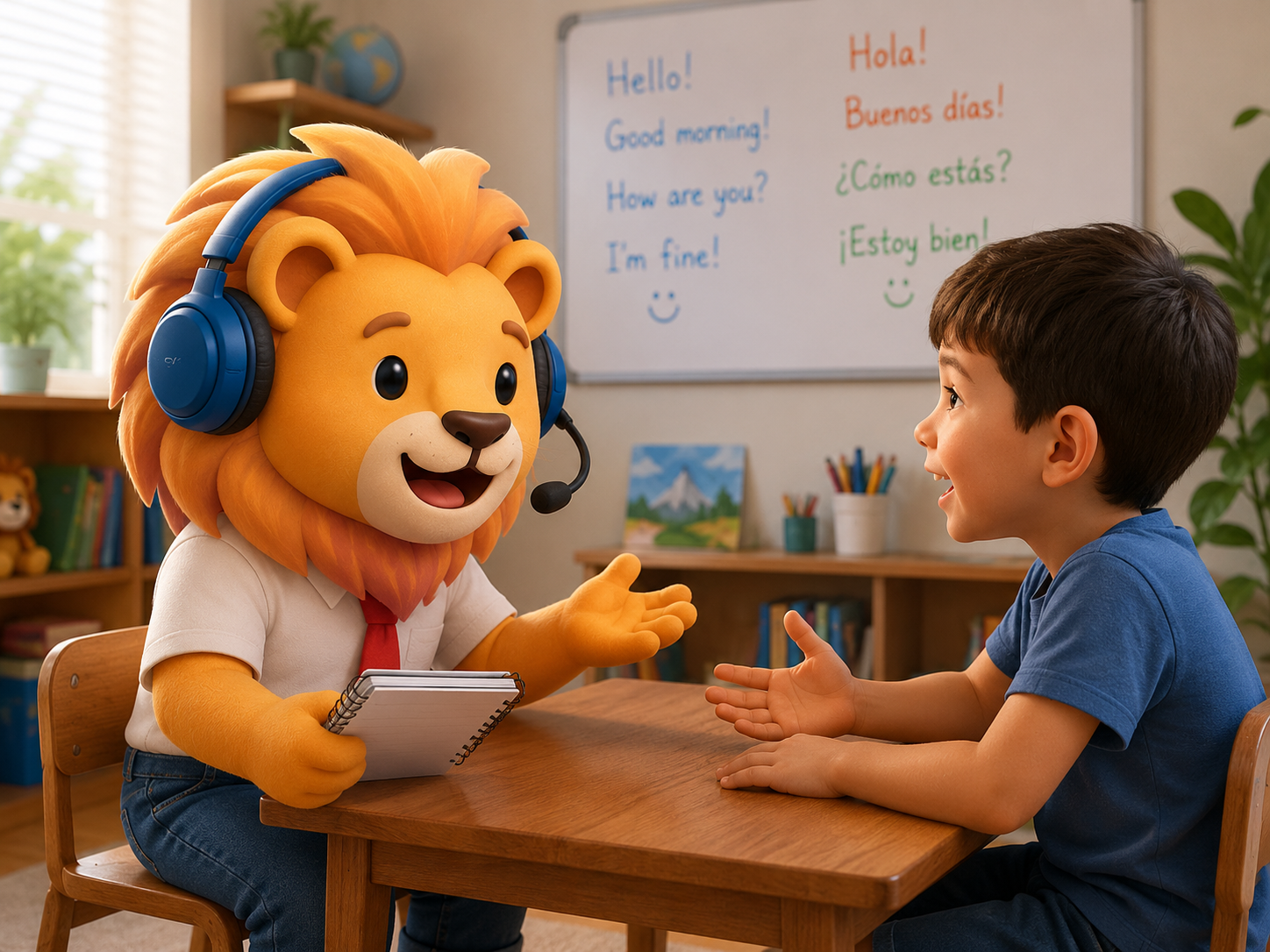
If you've watched your child memorize a hundred words in an app and still freeze when it's time to say something out loud, you already know the hard truth about language learning: vocabulary is easy, speaking is everything.
So when "AI tutors for kids" started appearing everywhere, it's fair to be both hopeful and skeptical. Can a piece of software really help a six-year-old open up and talk in a new language? Or is it just another screen promising more than it delivers?
This is an honest answer — the benefits, the genuine limitations, and the things technology is quietly getting very good at. We build a kids' AI tutor ourselves (Chat with Leo), so we have a point of view. But our goal here is to help you decide clearly, not to oversell.
Children learn to speak by speaking and making mistakes. Not by tapping. Not by watching. By producing language, getting gently corrected, and trying again — thousands of small times.
The problem has always been access to that practice. A patient human who will let your child stumble through "I... I want... the red apple" for the tenth time, without sighing, without judging, available right after dinner on a Tuesday? That person is rare and expensive. Most kids get a couple of hours a week in a classroom of twenty, where the shy ones rarely speak at all.
This is the gap a good AI tutor is designed to fill. Not to replace a teacher or a parent — to give your child the one thing they can't get enough of: low-pressure speaking time, on demand.
A 2025 study in Humanities and Social Sciences Communications found that AI conversation partners measurably improved learners' speaking skills while reducing their anxiety — because there's no fear of being laughed at. For children, who often clam up precisely because they're afraid of getting it wrong, that "judgment-free" quality isn't a nice-to-have. It's the whole point.
Let's be specific about the real benefits, not the hype.
That last point matters more than people admit. The highest-quality input for language learning — patient, responsive, one-on-one conversation — was historically a luxury good. Technology is turning it into something close to a utility. For most families, a kids' AI tutor is the single most cost-effective way to get a child actually speaking.
A trustworthy guide tells you where it breaks. Here's where AI tutors have genuinely struggled.
1. They don't replace human warmth. An AI is a wonderful practice partner. It is not a substitute for a parent reading a bedtime story or a teacher who notices your child had a hard day. The goal is to make your child a confident speaker so their real human conversations get richer — not to outsource connection.
2. Most AI was never built for children. This is the big one. The majority of "AI tutors" are general-purpose chatbots with a kid-friendly skin. They assume an adult's vocabulary, an adult's patience, an adult's ability to stay on a topic. Drop a four-year-old into that, and it falls apart — the AI talks over them, uses words they don't know, and has no idea whether they're actually learning.
3. Kids' voices are hard to understand. Children speak quietly, mumble, trail off mid-sentence to think, and sit in noisy living rooms with a sibling shouting in the background. Generic voice AI — tuned for a clear adult speaking into a headset — mishears them constantly. Nothing kills a child's confidence faster than saying the right thing and being told "I didn't catch that."
Here's the encouraging part: these last two limitations are engineering problems, and engineering is solving them fast. The question for a parent isn't really "is AI good enough yet?" It's "which AI tutor has actually done the work to fix these?"
This is where the choice gets clear, and where we'll be upfront about why we built Chat with Leo the way we did. The gap between a kids-first tutor and a repurposed adult chatbot is enormous, and it shows up in four places.
A generic voice assistant is built for an adult speaking clearly into a headset. We tuned Leo's listening specifically for how young children actually talk: it waits longer when a child pauses mid-thought instead of cutting them off, it tries hard not to give up on a quiet or timid voice, and we test it in the real, messy rooms kids live in — not a silent studio.
We'll be honest with you here, because this is where every voice AI is still imperfect: understanding a very small voice over a noisy living room is genuinely hard, and no tool — ours included — gets it right every single time. A shouting sibling or a mumbled half-word will still occasionally trip it up. What we can promise is that we treat this as a first-class problem rather than an afterthought: we keep tuning for kids' voices, and this is the area of voice technology improving the fastest, so it gets noticeably better over time. A tutor designed around a child's voice from the start will understand your child far more often than a generic chatbot that was never built for them — even if neither is flawless yet.
This is the feature that separates a tutor from a chatbot, and it's the one we're proudest of. A generic AI chat forgets your child the moment the conversation ends. Every session starts from zero.
Leo doesn't. It quietly remembers which words your child struggled with and gently brings them back in later sessions — until your child has genuinely mastered them. And here's the part that respects your child: once a word is truly learned, Leo stops drilling it. No nagging, no re-teaching something they already know. A mistake is carried forward only until it's fixed, then it gracefully retires. That's how a good human tutor works — and almost no generic AI chat does it.
Free-form chat is fun for five minutes and then drifts. Leo follows a structured, sequential curriculum built specifically for young learners — starting with greetings and feelings, building through family, food, and the world, all the way to holding a real little conversation. Each lesson has a clear "I can…" goal ("I can tell a tiny story," "I can ask Leo a question"). For a more advanced child, it starts a little further along so they're never bored. It's a path, not just a chat — months of fresh, age-appropriate lessons rather than the same open-ended prompt every day.
A three-year-old and a ten-year-old should not be spoken to the same way — and Leo doesn't. With younger children it's slower, sillier, endlessly repetitive, and never says "wrong." With older kids it's livelier, asks "why," uses light humor, and skips the baby talk that tweens find off-putting. The teaching style itself bends to the child.
And it knows when to stop. Every session has a deliberate time limit, by design — because a child's attention span is short, and past a certain point a "lesson" stops being a lesson and turns into aimless chit-chat or repetition that no longer teaches anything. A focused, time-boxed session is built around how children actually learn: a quick warm-up and review, a short burst of new practice, and a small playful challenge to finish — then it's done, while it still feels good. That's not a limitation we tacked on. It's the shape of an effective learning period, and it's why a handful of focused minutes with Leo does more than an open-ended chat that drags on until your child loses interest.
None of this is magic. It's the unglamorous, kid-specific engineering that a general chatbot simply never did.
Here's something we'll say plainly, even though it's tempting to make the AI tutor sound like the only thing your child needs: conversation practice works best when it sits on a foundation. A child speaks more confidently when they already have the words — and they pick up words best through variety, not a single screen doing one thing.
That's why Leo is one part of Voiczy, not the whole of it. Around the speaking practice, we build the foundation the classic, proven way:
Then Chat with Leo ties it together — your child uses those words out loud, and Leo recycles the ones they've been learning into real conversation. Books and games build the vocabulary; speaking practice turns it into fluency. Each makes the other work better. That blend — modern AI conversation plus the timeless methods that have always taught kids to read and play their way into a language — is the whole point. No single trick; a complete path.
Briefly, because it matters. A tutor built for children should be focused only on age-appropriate learning, give you a summary of each session so you can see what your child practiced, and stay fully under your control. With Leo, you decide if and when it's available, and you get visibility into every session. We also build in daily time limits — short, intentional practice instead of another thing to be glued to. Good learning should fit into your family's life, not take it over.
Here's our honest, weighed answer.
On its own, no. Nothing replaces a loving home and real human relationships, and no tool teaches a language without your child putting in the reps.
As a speaking partner, absolutely yes — and remarkably well. For the specific, crucial, historically-expensive job of getting a child to speak out loud, often, without fear, a well-designed AI tutor is one of the best things to happen to language learning in a generation. It turns the most valuable kind of practice from a luxury into something any family can afford.
The catch is design. A generic voice chatbot will frustrate your child with misheard words, adult-level talk, and zero memory. A tutor genuinely built for kids — one that understands small voices, remembers their mistakes, follows a real curriculum, and speaks to them at their age — is a different thing entirely.
That's the tutor we set out to build. If you'd like to see it in action, you can meet Leo here — and watch your child do the one thing every other app has been promising: actually start talking.
At what age can a child start with an AI language tutor? A well-designed one works from around age 3. The key is that it adapts its vocabulary, pace, and patience to the child — Leo is built for ages 3–14 and changes how it speaks across that range.
Will an AI tutor understand my child if our house is noisy? This used to be a real weakness of voice AI, and it's the area improving fastest. A kids-first tutor is tuned for quiet, mumbly, easily-distracted young speakers in real-world rooms — which is exactly what Leo is designed for.
How is this different from just letting my child talk to a general AI chatbot? A generic chatbot forgets your child between sessions, talks at an adult level, and has no lesson plan. A kids' tutor like Leo remembers their mistakes, retires words once mastered, follows a structured curriculum, and adapts its personality to your child's age. It's the difference between a chat and a tutor.
Is an AI tutor really cheaper than a human tutor? Dramatically. One-on-one human speaking practice runs around $20–50 an hour. A kids' AI tutor delivers daily practice for a few dollars a month — it's the most cost-effective way to get a child genuinely speaking.
Does this replace teachers or parents? No, and it shouldn't try to. It's a practice partner that builds your child's confidence so their real human conversations — at home, at school, with family — become richer and easier.
The research is clear, and so is the experience of thousands of families: confident speakers are made through patient, judgment-free, repeated practice. That used to be hard to find and expensive to buy.
Chat with Leo is our attempt to give every child that patient partner — one built for their voice, their age, and their mistakes, not an adult's.
Start your free trial today and turn screen time into speak time.
