Quick answer: Teach Dutch to your child by combining short daily exposure (10-20 minutes), age-appropriate input,
and one consistent voice they hear it from. Toddlers learn through songs and play, preschoolers through stories and
naming, elementary students through dialogue and reading. Use a voice-first app like Voiczy as the daily anchor and add
a real-life Dutch source — a parent, a friend, a grandparent on a video call — at least once a week.

If you're a parent reading this, you're probably one of three people:
- A Dutch speaker abroad who wants your child to keep the language
- An expat family in the Netherlands or Belgium and your child needs Dutch for school
- A parent who simply chose Dutch as your child's second language
This guide covers all three. The method changes a little by age, not by why you started.
If you've just moved to the Netherlands and need the practical school/system side — language schools, logopedie
referrals, VVE eligibility — read our companion
guide: How to Teach Your Child Dutch as an Expat Living in the Netherlands.
This article focuses on the at-home method.
Why early matters (but late is fine too)
Children's brains are wired for language acquisition until around age 7, then a second window stays open until
adolescence. Earlier is easier — but the difference between starting at 3 and starting at 6 is much smaller than parents
fear. What matters more than age is consistency: 15 minutes a day for a year beats one hour a week.
How to teach Dutch to toddlers (ages 2-3)
Toddlers don't study. They absorb. Your job is to put Dutch in the air around them.
- Sing first, talk second. Dutch nursery songs — "Hoofd, schouders, knie en teen", "In de maneschijn", "Klein klein
kleutertje" — teach Dutch rhythm and the famously tricky vowel sounds before any words make sense. Play them in the
car, at bath time, before bed. Repetition is the feature, not the bug.
- Name things, don't translate. Point at a duck and say "eend". Don't say "that's an eend, which means duck".
Translation slows toddlers down. Direct labelling is what builds the connection their brain is looking for.
- One Parent One Language (OPOL). If only one parent speaks Dutch, that parent speaks only Dutch to the child.
Mixing weakens the signal at this age.
- Short and frequent. Three 5-minute Dutch moments beat one 30-minute session. Toddlers can't hold focus for long,
but they can return to the language ten times a day.
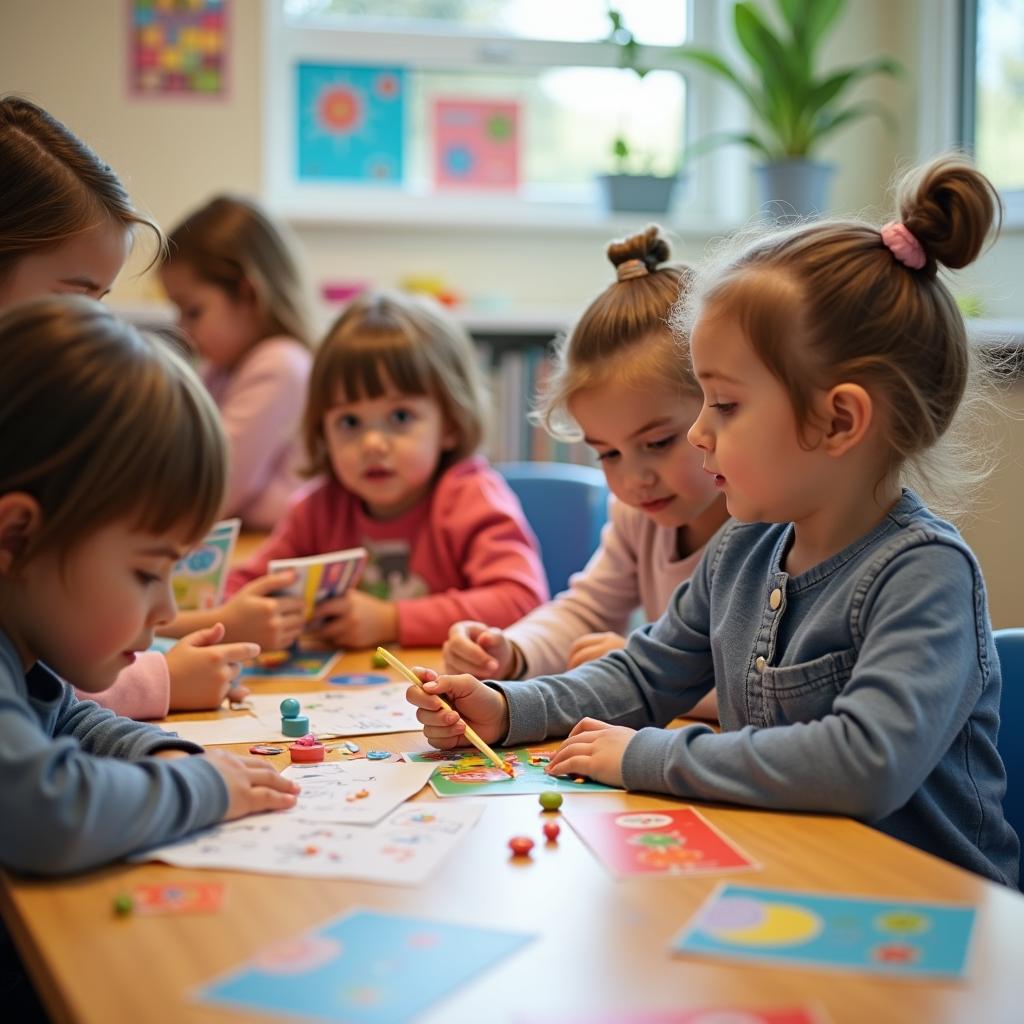
How to teach Dutch to preschoolers (ages 3-5)
Preschoolers can do more, but they still need it to feel like play.
- Bilingual story books. Read the same Dutch-English book together for a week. By day three they'll predict the next
page; by day five they'll say words ahead of you. Voiczy's speak-along bilingual stories are built for this exact age.
- Voice-first apps over screen-heavy ones. Apps that demand reading or matching pictures are a poor fit for
preschoolers — their thumbs aren't the bottleneck, their ears are. A voice tutor that asks them to say the word
back is far more effective than one that asks them to tap a picture.
- Routines beat lessons. Pick one Dutch moment per day and protect it: morning breakfast, walk to peuterspeelzaal
or school, pre-bedtime story. The time slot matters more than the activity.
- Don't correct mid-sentence. When your preschooler mangles a sentence, repeat it back correctly without making it a
lesson. Their brains catch the difference without you flagging it.
How to teach Dutch to elementary students (ages 5-10)
This is the age where structured input starts to pay off.
- Reading comes online. Pair audiobooks with the printed text in Dutch — listening while seeing the words is one of
the highest-leverage activities at this age.
- Conversation, not vocabulary lists. Word lists are how Dutch-as-a-school-subject is taught at school in
non-Dutch-speaking countries. They produce children who can pass a test in Dutch but can't order an appelflap at the
bakery. Daily two-way conversation — even with an AI tutor — is what produces speakers.
- Tie it to something they care about. Dutch football, Jeugdjournaal, Dutch streamers and YouTubers they actually
like, Dik Trom, Annie M.G. Schmidt's books, Pluk van de Petteflet. Language attached to interest sticks; language
attached to homework doesn't.
- Real-world Dutch, even tiny doses. A weekly video call in Dutch with a grandparent, a Dutch summer camp, an
exchange family — anything that signals "this language is real" is worth more than another worksheet.
How to teach Dutch as a whole family
Some Dutch-speaking parents stop using Dutch at home because their partner doesn't speak it. This is the single biggest
mistake we see in expat families.
- Protect the home Dutch. The school will handle the local language. The home is the only place Dutch gets spoken —
if the home gives up, the language goes.
- Don't fear the mix. Bilingual children mix languages for years and then sort them out by age 4-5 with no special
intervention. Mixing is not confusion; it is a transitional phase of competence.
- Make Dutch the language of one routine. Dutch dinner, Dutch bath time, Dutch zaterdagochtend. The whole family —
including the non-Dutch parent — can join. Showing the child that Dutch is normal in this house, even imperfect Dutch,
matters more than getting the grammar right.
Dutch in the Netherlands vs Dutch in Belgium (and what about Frisian?)
Dutch is the official language of two countries, with two slightly different standards:
- Netherlands Dutch (Standaardnederlands) — what most schoolbooks, NPO television, and apps use. The Dutch
you'll hear from Dutch teachers and on Dutch news.
- Belgian Dutch (Vlaams / Flemish) — same written language, slightly different vocabulary
(frigo vs koelkast, tas vs kopje) and a softer, more melodic accent. Used in Flanders and Brussels'
Dutch-speaking schools. VRT is the public broadcaster.
For children, both are mutually intelligible. A child raised on Dutch Klokhuis will understand Belgian Dutch
school content and vice versa. Don't worry about which "version" your child gets.
A note on Frisian (Frysk): in the province of Friesland (north of the Netherlands), Frisian is co-official.
Frisian-speaking schools teach in Frisian first and Dutch second. If you live there, you'll have both languages
in your child's life automatically — and that's fine. Your child will acquire both.
How the CITO Toets works (and why Dutch literacy by age 11 matters)
In the Netherlands, the Centrale Eindtoets (formerly CITO Toets) at age 11 helps determine which secondary
school track your child enters: VWO (academic, university-bound), HAVO (general), or VMBO (vocational). The test
heavily weighs Dutch reading and writing.
This is the highest-stakes Dutch literacy moment for school-age children of expat families:
- Strong Dutch by age 11 unlocks VWO/HAVO. Weak Dutch traps the child in VMBO regardless of their actual ability.
- Bilingual children whose home language reading was protected (any language — Polish, Arabic, English, Turkish,
whatever) tend to do better on the CITO than monolingual Dutch peers, because general literacy transfers.
- Don't drop home-language reading thinking it will help with CITO. The opposite is true.
What about Dutch for families just moved to the Netherlands or Belgium?
If your child is starting at a Dutch school with no Dutch, language-specific schools (taalschool) and reception
classes (schakelklas or nieuwkomersklas) handle the first 1-2 years. Children in Dutch schools typically reach
conversational fluency in 12-18 months and academic fluency in 3-5 years. Younger children adapt faster; if your child
is under 6, expect rapid progress.
For the practical side — VVE eligibility, logopedie (speech therapy), how to navigate the school system — see
our Dutch as an Expat in the Netherlands
guide.
Your job at home isn't to replace school. It's to:
- Reduce the stress. A child silent for the first 6 months is normal. This is
the silent period, and it is healthy.
- Front-load high-frequency phrases. "Ik heet…", "Ik ben moe", "Ik moet naar de wc", "Ik begrijp het niet". 30
phrases get a child through the first month at school.
- Practice without judgement. A voice-first app where they can speak Dutch without classmates listening builds
confidence faster than any tutor.
- Voiczy — voice-first Dutch lessons for kids 3-12, with bilingual stories, an AI conversation tutor, and games
designed for short daily sessions. Built by expat parents in the
Netherlands. Try Dutch on Voiczy free for 7 days.
- Dutch public library (Bibliotheek) — free children's books in Dutch, often with bilingual sections in major
cities.
- NPO Zapp — Dutch public service kids' TV. Free, ad-free, and the dialogue is paced for native learners, which is
the right level for proficient second-language kids.
- Video calls with Dutch-speaking relatives — the cheapest, highest-leverage tool you have. 20 minutes a week with a
Dutch-speaking grandparent is worth more than any premium app.
Frequently asked questions
How do I teach Dutch to my child if I don't speak Dutch myself?
You don't need to be fluent yourself. You need to be the structure-setter. Pick one daily Dutch moment, use a
voice-first app or audio source for that moment, and protect the time. The app or audio source is the teacher; you are
the consistency keeper.
What's the best age to start teaching Dutch to a child?
Earlier is easier, but starting now is always better than waiting. A 3-year-old has a slight neurological advantage
over a 6-year-old, but a 6-year-old who practices daily for a year will outpace a 3-year-old who practices weekly. Don't
optimize for the perfect start; optimize for the next 365 days.
How long until my child can speak Dutch?
For a child living in the Netherlands or Belgium: 6-12 months for basic conversation, 3-5 years for school-level
fluency. For a child learning Dutch abroad with daily practice: 12-18 months for confident sentences, 3-5 years for
complex conversation. Receptive understanding always comes first — your child will understand long before they speak.
Should I correct my child's Dutch mistakes?
Recast, don't correct. If they say something wrong, say it back correctly in your next sentence without flagging the
error. Direct correction in the moment makes children clam up; recasts let them keep talking and absorb the correction.
My child is mixing Dutch and my native language in the same sentence. Should I worry?
No. Code-switching is a normal developmental stage, not a problem. Bilingual children sort their languages by ages 4-5
with no special intervention. The only thing that creates lasting issues is when parents reduce input — keep speaking
Dutch; the mixing will stop on its own.
Should we worry about the CITO Toets / Eindtoets?
If your child will be in Dutch school at age 11, yes — but worry constructively. Pair Dutch reading practice
(daily) with strong reading in your home language. Avoid the trap of dropping the home language to "focus on
Dutch"; bilingual literacy outperforms monolingual literacy on the CITO consistently.
Is Dutch hard for a young child to learn?
No. Dutch sounds difficult to adult learners (the g sound, the diphthongs) because their mouths and ears are already
trained for another language. A 3-year-old's mouth and ears are still forming — Dutch is no harder for them to acquire
than any other language.
Every child's Dutch journey looks different. Some start speaking in three months and others wait a year. What every
successful family has in common is the same thing: they showed up, in Dutch, every day, for years.
Try Voiczy free for 7 days and see how your child responds to a voice-first
Dutch program built for kids 3-12.
